

Acoustic Pianos with Modern Technology: SILENT, TransAcoustic, and Disklavier
Many people begin their piano search knowing they want an acoustic piano, with real hammers, strings, and a wooden soundboard. They’re drawn to its natural sound, responsive touch, and the experience of playing a traditional instrument. What they may not realize is that an acoustic piano can now also include headphone practice, adjustable volume, additional instrument sounds, recording, and even performance playback.
Yamaha SILENT, TransAcoustic, and Disklavier pianos are acoustic uprights and grands with factory-integrated technology for features such as headphone practice, adjustable volume, recording, and performance playback. The available features depend on the system.
These features don’t replace the acoustic piano. They give players more ways to practice, listen, record, and enjoy the instrument in different situations and at different times of day.
The idea of expanding what an acoustic piano can do isn’t new. Player and reproducing pianos have brought performances into homes and public spaces for generations. What has changed is the sophistication of today’s factory-integrated systems and the range of features they can add while preserving the piano’s traditional acoustic function.
How are these pianos different from digital pianos?
The fundamental difference is the instrument at the core.
When the added technology isn’t in use, a Yamaha SILENT, TransAcoustic, or Disklavier upright or grand can be played as a traditional acoustic piano. The hammers strike the strings, the soundboard resonates, and the instrument produces its sound acoustically.
A digital piano produces sound electronically and uses a keyboard designed to recreate aspects of an acoustic piano’s touch and response. Both categories can offer useful technology, but they begin with different types of instruments.
Yamaha’s three systems expand the acoustic piano in different ways:
- SILENT Piano allows private practice through headphones.
- TransAcoustic Piano can reproduce digital sounds through the piano’s own soundboard.
- Disklavier can record and physically reproduce performances on the acoustic piano itself.
The right choice depends less on which system offers the most features and more on which capabilities would be most useful to you.
If you’re still deciding among broader piano categories, Acoustic, Digital, or Hybrid: Which Type of Piano Is Right for You? provides a fuller comparison. Our Guide to Buying an Acoustic Piano can also help with questions about size, quality, cost, tone, touch, and in-person comparison.
Three ways Yamaha expands the acoustic piano
Each system is designed around a different primary use. The best fit depends on what you want the technology to help you do.
Yamaha SILENT Piano: Play when the house needs quiet
A Yamaha SILENT Piano is designed for players who want the touch and response of an acoustic piano but also need the option to practice privately.
A child may need to practice while someone works in the next room. An adult pianist may finally have time after the rest of the household has gone to bed. In an apartment or shared home, even daytime practice may require some consideration.
Played normally, the piano operates acoustically, with felt hammers striking the strings. When SILENT mode is engaged, a stopping mechanism prevents the hammers from reaching the strings. Noncontact sensors detect how the keys are played, and the selected digital sound is heard through headphones.
Current Yamaha SILENT Piano systems include voices sampled from the Yamaha CFX and Bösendorfer Imperial concert grands, along with additional piano and instrument sounds. Binaural sampling and sound-modeling technology are designed to create a more natural sense of space and resonance through headphones.
Depending on the system, players may also be able to record performances, connect compatible devices, and use Yamaha’s Smart Pianist app.
For many households, SILENT mode may be the feature that allows the piano to be played far more often.
Yamaha TransAcoustic Piano: Adjustable sound through the piano’s soundboard
A Yamaha TransAcoustic Piano is designed for players who want more control over volume without giving up the physical experience of sound resonating through an acoustic piano.
When TransAcoustic mode is engaged, a stopping mechanism prevents the hammers from striking the strings. Sensors detect how the keys are played, and transducers convert the selected digital sound into vibrations that travel through the piano’s soundboard. The soundboard and body of the instrument then act as the speaker system, so the sound comes from the piano itself rather than from conventional speakers.
This allows the player to lower the volume while still hearing and feeling the instrument resonate. Depending on the model and system, players can also choose voices sampled from the Yamaha CFX and Bösendorfer Imperial concert grands, use additional instrument sounds, record performances, connect compatible devices, or practice privately with headphones.
TransAcoustic technology can also blend a digital voice with the piano’s natural acoustic sound, opening up additional tonal and creative possibilities.
For a household, studio, school, or performance space where volume flexibility matters, TransAcoustic can make an acoustic piano easier to use in more situations.
Yamaha Disklavier: Record and reproduce acoustic performances
A Yamaha Disklavier is designed for people who want an acoustic piano that can record a performance and then physically reproduce it on the instrument itself.
During recording, sensors capture the movement of the keys, hammers, and pedals. During playback, the keys and pedals move again, and the performance is heard through the piano’s strings and soundboard. Rather than simply playing back an audio recording, the piano recreates the performance acoustically.
For listeners, Disklavier can bring professionally recorded piano performances into the home. Compatible models include built-in music and may also provide access to Yamaha’s Premium Pass subscription services, including On Demand selections, Disklavier Radio, and synchronized DisklavierTV performances. Available services depend on the model, subscription, and location.
For pianists, students, and teachers, Disklavier can also be a recording and learning tool. A player can record a lesson, practice session, or performance and listen back without having to play at the same time. Teachers can use playback to review rhythm, dynamics, phrasing, pedaling, and interpretation.
For schools, universities, and performance organizations, compatible systems can support lessons, masterclasses, recording, and connected performances. A performance transmitted from another location can be reproduced on a Disklavier, allowing the music to be heard through an acoustic piano even when the performer is elsewhere.
Yamaha Disklavier offers the broadest range of recording, playback, entertainment, and connected capabilities among these three Yamaha systems. It also generally represents the largest investment, making it especially important to consider which of those capabilities you’re likely to use. For full specifications and current system details, see Yamaha’s official Disklavier product information.
Which technology fits the way you’ll use the piano?
All three systems begin with an acoustic piano, but each emphasizes a different way of using it. This comparison highlights the primary benefit of each system, even though some features overlap.
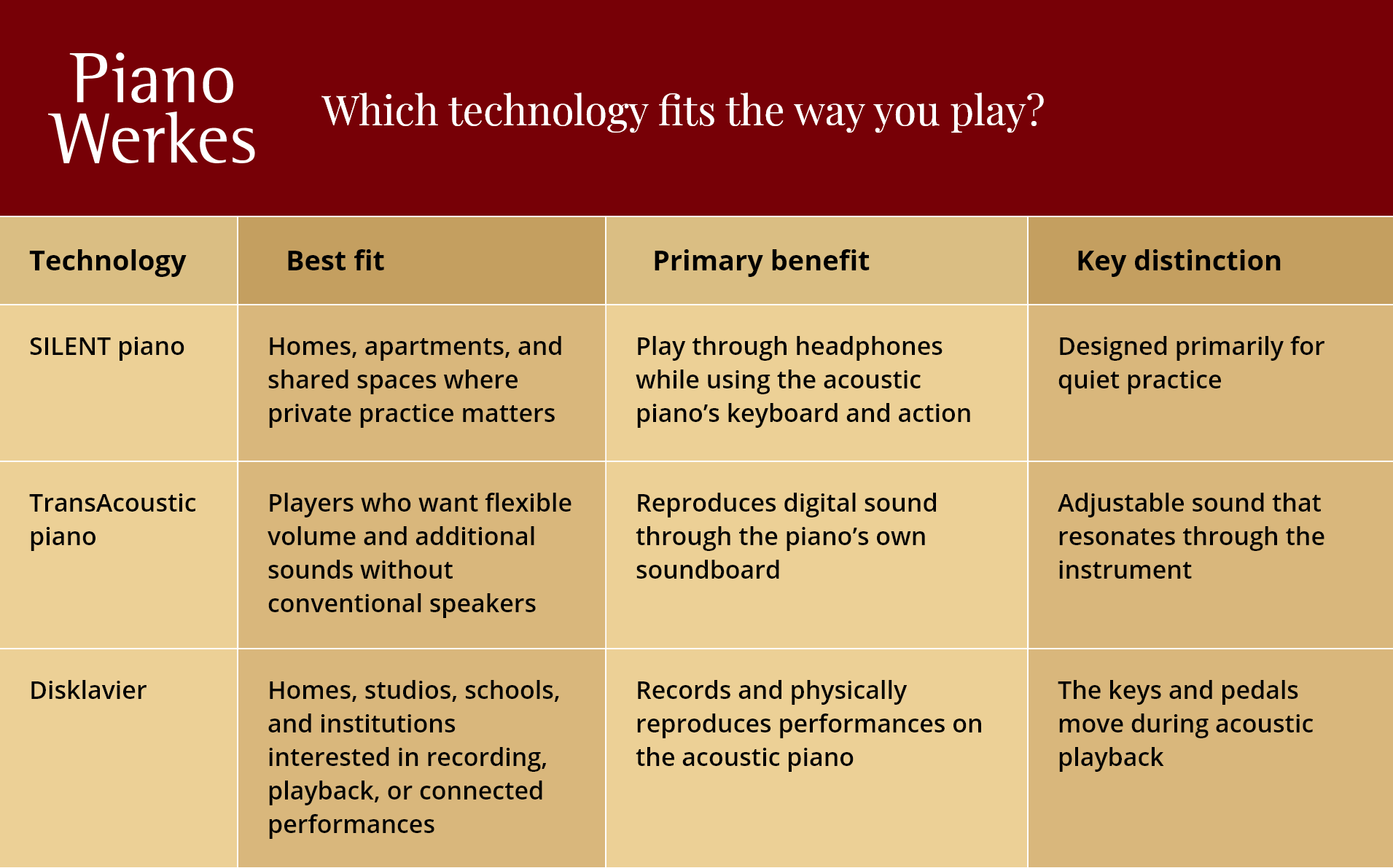
| Technology | Best fit | Primary benefit | Key distinction |
|---|---|---|---|
| SILENT piano | Homes, apartments, and shared spaces where private practice matters | Play through headphones while using the acoustic piano's keyboard and action | Designed primarily for quiet practice |
| TransAcoustic piano | Players who want flexible volume and additional sounds without conventional speakers | Reproduces digital sound through the piano's own soundboard | Adjustable sound that resonates through the instrument |
| Disklavier | Homes, studios, schools, and institutions interested in recording, playback, or connected performances | Records and physically reproduces performances on the acoustic piano | The keys and pedals move during acoustic playback |
Some capabilities overlap, so the best choice usually comes down to the feature you expect to use most often and the models available within your preferred piano size and style.
What should you consider when choosing a technology-enhanced acoustic piano?
Choosing among SILENT, TransAcoustic, and Disklavier involves more than comparing features. You’re also choosing the acoustic piano those features are built into, so its size, tone, touch, price, and fit for the room still matter.
Start by considering who will use the piano, when they’re most likely to play, and which capabilities would make the instrument more useful in your home, studio, school, or performance space.
Questions to consider include:
- Will private headphone practice be the feature you use most?
- Do you want adjustable sound that resonates through the piano itself?
- Would you regularly use recording or acoustic performance playback?
- Are app connectivity or subscription-based services important to you?
- Which available acoustic piano feels and sounds best when the technology isn’t in use?
- Does the system fit your budget and the way you expect to use the piano over time?
The technology should support the way you play and listen, but the decision still begins with choosing an acoustic piano you enjoy on its own.
Compare acoustic pianos with modern technology in Albuquerque
The differences among SILENT, TransAcoustic, and Disklavier pianos are easier to understand when you can experience them for yourself.
At Pianowerkes of Albuquerque, you can compare available Yamaha uprights and grands, hear how each system works, and evaluate the piano’s acoustic tone and touch when the technology isn’t in use. Our team can also demonstrate features such as headphone practice, adjustable volume, recording, and performance playback.
Visit our Abuquerque showroom at 7410 Washington St., or call 505-338-0028 to ask about current models and schedule a one-on-one demonstration.
Frequently asked questions
What’s the difference between SILENT, TransAcoustic, and Disklavier pianos?
A Yamaha SILENT Piano is designed primarily for private headphone practice while retaining the acoustic piano’s keyboard and action. A TransAcoustic Piano can reproduce adjustable digital sound through the piano’s own soundboard. A Disklavier can record and physically reproduce performances using the acoustic piano’s keys, pedals, strings, and soundboard.
Some capabilities overlap, so the best choice depends on which features would be most useful to you and which acoustic piano you prefer.
Does the added technology change how the piano feels?
When played acoustically, the piano retains its traditional keyboard and action. Yamaha’s current SILENT and TransAcoustic systems use noncontact sensors designed to detect key and hammer movement without adding resistance or changing the feel of the keys.
In SILENT or TransAcoustic mode, the player is still using the piano’s acoustic action, although the sound is produced digitally rather than by the hammers striking the strings.
What happens when the technology is turned off?
The instrument can be played as a traditional acoustic piano. The hammers strike the strings, the soundboard resonates, and the piano produces sound acoustically without relying on the electronic features.
Is special maintenance required?
The acoustic piano still requires normal care, including tuning, appropriate climate conditions, periodic regulation, and service as needed.
The integrated technology generally doesn’t require day-to-day maintenance from the owner, but software or firmware updates and occasional technical service may be needed. Ask the dealer what support is available for the specific system and model you’re considering.
Will the technology become obsolete before the piano?
The acoustic piano is likely to remain playable much longer than any particular app, connection format, or online service remains unchanged.
That’s one advantage of these systems: the technology adds capabilities, but the instrument can still function as an acoustic piano without them. Some systems can receive software or firmware updates, although compatibility, connected services, and available features may change over time.
Before buying, ask what support and updates are available for the specific model and generation you’re considering.