
The Viennese Sound: What Makes Bösendorfer Pianos So Special?
In Vienna, music is more than an art form. It’s part of the city’s identity, shaped over centuries by legendary composers, gifted musicians, and generations of instrument makers. It’s a place where the pursuit of beautiful sound has become a tradition of its own.
That same spirit lives on in Bösendorfer pianos. Founded in Vienna in 1828, Bösendorfer has developed a sound known for its warmth, richness, and expressive character. But what is it about these instruments that gives them a voice all their own?
Vienna's distinctive musical voice
Mozart, Haydn, Beethoven, Schubert, Brahms, Mahler, and members of the Strauss family are among the composers whose work helped establish Vienna as one of the world’s great musical capitals. Their compositions were performed in churches, salons, opera houses, and concert halls, where musicians and audiences contributed to the city’s evolving traditions.
Over time, celebrated venues such as the Musikverein and Konzerthaus became important gathering places for Vienna’s musical community. The Musikverein, home to the Vienna Philharmonic‘s renowned subscription concerts, is especially closely associated with the orchestral tradition that continues to distinguish the city.
That tradition is often described through the term Wiener Klangstil, or “Viennese sound style.” In his New York Times article, A Sound Shaped by Time and Tools, music journalist Michael Cooper explores the Vienna Philharmonic’s characteristic sound, noting descriptions such as “plush,” “warm,” “rich,” and “sumptuous.”
Think of it as a musical dialect. Just as the way we speak carries its own inflections, rhythms, and expressions, the Viennese sound is shaped by tone, phrasing, articulation, and the relationship between individual voices.
Four qualities are often associated with the Viennese sound:
- Warmth: A rich, resonant tone that maintains depth and clarity, even in quiet passages.
- Blend: Individual instruments contribute to a unified sound without losing their distinct voices. You can still follow the oboe’s melody, the viola’s inner voice, or the horn’s tonal color, even as the orchestra plays together.
- Expression: Subtle changes in timing, phrasing, and dynamics give the music a natural, conversational quality.
- Singing tone: Melodies unfold with a connected, lyrical character.
These qualities aren’t exclusive to Vienna. What sets the city’s sound apart is how they come together through its instruments, musicians, and performance practices, passed from one generation to the next.
How instruments help shape the Viennese sound
One of the most interesting characteristics of the Vienna Philharmonic is its continued use of certain instruments that differ from those commonly found in other major orchestras.
These distinctions are more than a matter of tradition: The way an instrument is built influences its tonal character and the techniques musicians use to play it. Consider a few examples:
- The Viennese horn: With its distinctive double-piston, or Pumpen, valves, the Viennese horn differs from the modern rotary-valve horns used in many other orchestras. Its design contributes to its tonal character and flowing legato.
- The Viennese oboe: Differences in bore design, reed construction, and playing traditions give this instrument a character distinct from the French-system oboe commonly used elsewhere.
- Rotary-valve trumpets: Their construction and valve mechanisms influence tonal color and articulation, helping create the orchestra’s characteristic blend.
- Viennese timpani: Traditionally fitted with natural goatskin heads, these instruments add depth and resonance to the ensemble.
Yamaha's role in preserving Viennese musical traditions
The distinctive instruments of the Vienna Philharmonic have long been an important part of the orchestra’s sound. But preserving that tradition requires more than musicians committed to playing them. It also depends on instrument makers who understand their specialized designs.
By the early 1970s, the future of certain traditional Viennese orchestral instruments had become uncertain as fewer manufacturers continued producing them.
That’s why, at the request of the Vienna Philharmonic, Yamaha began collaborating with musicians in 1973 to help develop and manufacture these specialized instruments, including the Viennese horn and oboe. The result was the preservation of instruments that played an important role in maintaining the orchestra’s traditional sound.
Decades later, Yamaha became part of another chapter in Vienna’s musical history when it acquired Bösendorfer in 2008.
Today, Bösendorfer continues to build its grand pianos in Wiener Neustadt, near Vienna, carrying forward nearly two centuries of Austrian craftsmanship. You can explore more of that history in Classic Pianos’ article about the legacy of Bösendorfer pianos.
Inside the Bösendorfer: Craftsmanship and innovation
Just as the design of certain Viennese orchestral instruments influences their sound, Bösendorfer’s approach to piano making plays an important role in giving its instruments their recognizable character.
From the materials chosen and the way each piano is constructed to innovations that expand its range and expressive possibilities, every detail reflects a commitment to craftsmanship and sound. Some of these differences are found within the instrument itself, while others are immediately apparent in its design.
The resonance case principle
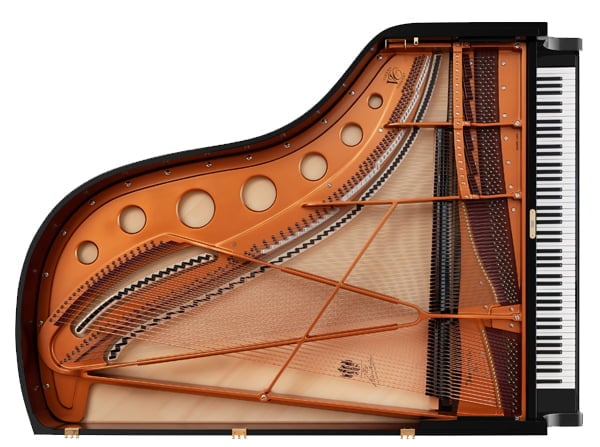
One of Bösendorfer’s defining characteristics is its resonance case principle.
While the soundboard plays a central role in a grand piano’s sound, Bösendorfer incorporates spruce extensively throughout its construction, including components of the piano’s case. This allows more of the instrument’s body to participate in the resonance created when a note is played.
Bösendorfer compares this approach to the construction of a violin, where the body itself plays an important role in producing sound.
It’s a design philosophy intended to produce a rich spectrum of tonal colors, resonance, and expressive possibilities.
The importance of Austrian spruce
The materials used in a Bösendorfer are equally important.
Austrian spruce is carefully selected for its acoustic properties and allowed to dry naturally before becoming part of a finished instrument. From preparing the wood to completing the instrument, the process takes approximately six years.
Beyond 88 keys: Bösendorfer's extended keyboards
Bösendorfer’s distinctive approach to piano design is also evident in its extended keyboards. While most grand pianos have 88 keys, the Bösendorfer 225 features 92, and the legendary 290 Imperial offers 97 keys spanning eight full octaves.
These additional bass notes expand the instrument’s range and contribute to its rich, orchestral resonance. They also allow pianists to perform certain compositions as originally written, including works that call for notes beyond the standard keyboard.
The Vienna Concert series
Bösendorfer continues to build on its heritage with the Vienna Concert (VC) series. Drawing on the design of its concert grand pianos, the series combines traditional craftsmanship with modern acoustic research and engineering to achieve greater power, projection, and dynamic range.
The Bösendorfer 214VC, for example, brings this concert-inspired design into a grand piano measuring approximately seven feet, offering pianists a broad range of expression in an instrument suited to spaces beyond the concert stage.
Where piano making meets fine art
Bösendorfer’s artistry extends beyond the sound of its instruments. Through its collector’s editions and design collaborations, the company brings together exceptional piano craftsmanship and the visual arts.
The Beethoven Chrome edition celebrates one of Vienna’s most influential composers, while the Porsche-designed grand explores a strikingly contemporary approach to design. Other artistic creations, including The Great Wave, show how Bösendorfer brings fine art into the design of its grand pianos.
A sound that opens around you
The craftsmanship behind a Bösendorfer is remarkable, but it’s at the keyboard that its character truly comes to life.
A note opens, expands, and reveals color. Melodies sing, while the bass provides depth and resonance. Like individual instruments within an orchestra, the different voices of the piano remain distinct while blending into a beautifully connected sound.
For the pianist, these qualities offer opportunities to explore subtle phrasing, dynamic contrasts, and expressive nuance. That responsiveness can make playing a Bösendorfer feel less like a performance and more like a conversation between the musician and the instrument.
It’s here that the parallel with the Viennese orchestral tradition becomes especially meaningful: the relationship between the instrument’s design and the musician’s technique shapes the resulting sound.
What makes the Viennese sound so enduring isn’t any single instrument, construction technique, or tonal quality. It’s the way generations of musicians and instrument makers have continued to build on a shared tradition, preserving what makes it special while finding new ways to express it. In a Bösendorfer, that history is more than something to appreciate. It’s something you can hear, feel, and become part of every time you sit down to play.
Experience the Viennese sound at PianoWerkes in Albuquerque
As part of the Classic Pianos dealership group, which has sold more Bösendorfer pianos than any other worldwide, PianoWerkes brings exceptional experience with these remarkable instruments. That commitment has also earned the company Bösendorfer’s first-ever Global Dealer of the Year award.
At our Albuquerque showroom, we invite you to explore our Bösendorfer grand pianos and discover their warmth, richness, and responsiveness firsthand.
Stop by our showroom at 7410 Washington St. NE, Albuquerque, NM 87109, or call 505-338-0028 to learn more about our Bösendorfer collection.


